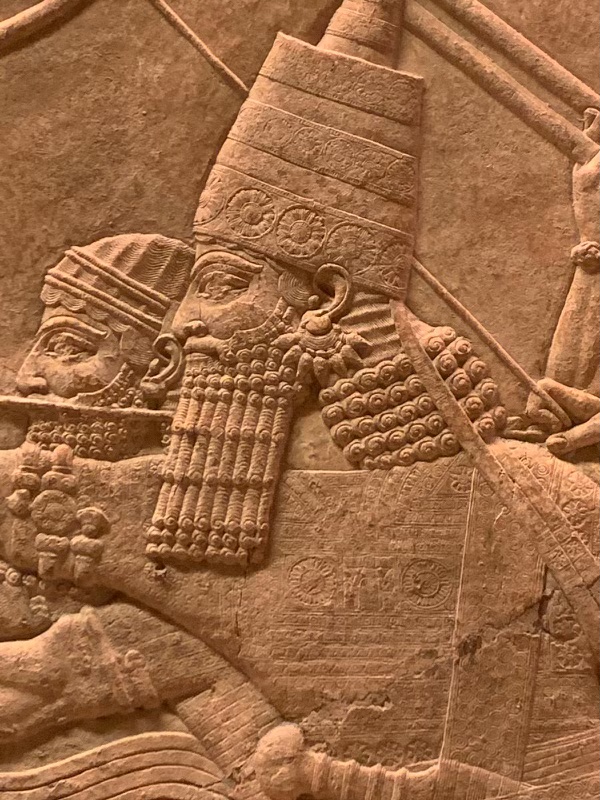
Ashurbanipal - King of Assyria
The brutal warrior king who gathered the
ancient literature of Mesopotamia
in his great library at Nineveh
- preserving the Epic of Gilgamesh and its Flood story for us,
-
and 2,700 years later inspiring Elif Shafak's wonderful novel There Are Rivers
in the Sky.
Our 81st great-grandfather
|
Our brutal ancestor Ashurbanipal |
|
|
When you go far enough back in a family tree, you inevitably meet some rather unpleasant ancestors. Our 81st great-grandfather, Ashurbanipal, King of Assyria from around 669 to 631 BCE, certainly belongs among them. Cruelty was hardly new in our Assyrian family. Our 85th great-grandfather, Tiglath.III had conquered Babylonia, and our 83rd great-grandfather Sennacherib had devastated rebellious cities. But Ashurbanipal left us particularly horrifying pictures of what Assyrian warfare meant. The magnificent stone reliefs from his palaces show enemies being flayed, impaled and dismembered, prisoners tortured and humiliated, and civilians slaughtered. Ashurbanipal himself proudly described the terrible punishments inflicted on people who resisted him. One extraordinary relief even shows an Assyrian soldier cutting open a pregnant woman. Looking at these scenes today, it is difficult not to think of the images we have seen from the same region in our own lifetime — brutal bearded warriors terrorizing people who happened to belong to the wrong religion or community.
Yet here comes the great paradox in our ancestor's
life. For this terrifying warrior was also an intellectual. Ashurbanipal
could read and write and had an almost obsessive passion for collecting
the knowledge and literature of the ancient world. |
|
|
|
|
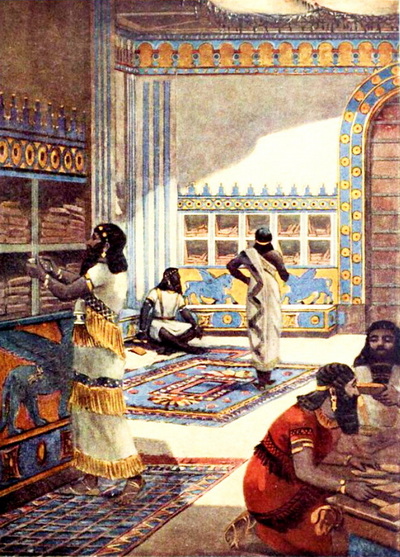 |
Ashurbanipal built up his extraordinary royal library in Nineveh, the Assyrian capital whose ruins today lie beside Mosul in northern Iraq. More than 30,000 clay tablets and fragments from the library have survived. They contain prayers, medical knowledge, magic, dictionaries, divination, history, myths and literature in the cuneiform languages of ancient Mesopotamia. Ashurbanipal had been trained as a scribe and could read Akkadian and Sumerian. His passion for collecting was enormous. He wrote to centers of learning throughout his empire demanding important texts and sent scribes to find and copy ancient Babylonian works. But we should probably not romanticize our ancestor too much! Ashurbanipal was an imperial ruler, and some of his collecting was backed by the enormous power of the Assyrian state. Knowledge, like gold and other treasures, could become war booty. Then came one of history's wonderful ironies. Nineveh was destroyed in 612 BCE. Its palaces burned and the great Assyrian Empire disappeared. But when the buildings collapsed, thousands of clay tablets were buried beneath the ruins. The fires that destroyed the palaces may even have helped bake and preserve some of them. And there they lay silently for more than two thousand years. When archaeologists excavated Nineveh in the nineteenth century, thousands of the tablets eventually came to the British Museum. Among them was one of the oldest great works of literature in human history. |
| Gilgamesh - and the Flood before Noah | |
|
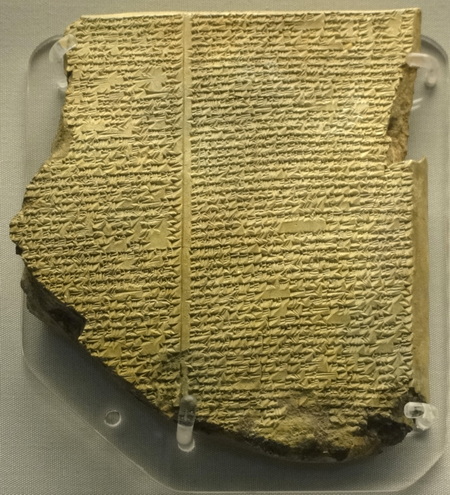
The Epic of Gilgamesh was already ancient when our ancestor Ashurbanipal collected it. Its hero, Gilgamesh, was the legendary king of Uruk, possibly based on a real ruler who lived in the third millennium BCE. The epic follows his friendship with the wild man Enkidu, his grief after Enkidu's death and his desperate search for the secret of immortality. But the part that caused a sensation when the tablets from Ashurbanipal's library were deciphered in the nineteenth century was the story of the Flood. Gilgamesh meets Utnapishtim, who tells how the gods decided to destroy humanity in a catastrophic flood. Warned beforehand, he builds a great boat, takes aboard his family and living creatures, survives the deluge and finally releases birds to discover whether the waters have receded. It sounded astonishingly like Noah's Ark. But the Mesopotamian Flood tradition was centuries older than the biblical text. Suddenly Victorian readers realized that one of the Bible's most famous stories had deep roots in the much older civilizations of Mesopotamia. Other echoes are equally fascinating. Enkidu is created from the earth and lives innocently in nature before sexuality and civilization change him, inviting comparison with Adam and Eden. Gilgamesh and Ecclesiastes both brood over the same eternal problem: our lives are short, death is unavoidable, so what gives human existence meaning?
Our ancestor Ashurbanipal never found immortality.
But by collecting these clay tablets, he unintentionally gave a kind of
immortality to the people who had written them. |
 |
|
From our ancestor Ashurbanipal to Elif Shafak |
|
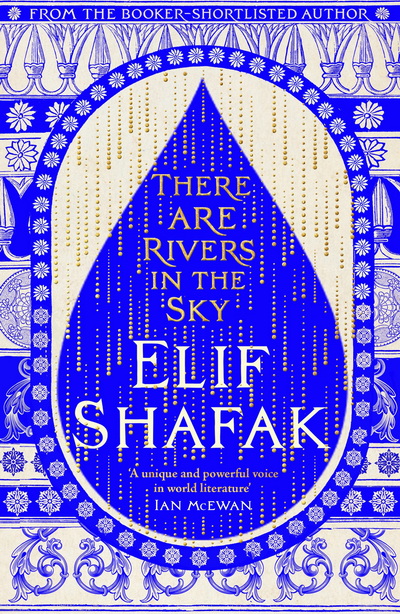 |
This is where my old genealogy suddenly reaches right into contemporary
literature. Nearly 2,700 years after our 81st great-grandfather gathered
the clay tablets of Mesopotamia in Nineveh, they flow through Elif
Shafak's beautiful novel There Are Rivers in the Sky. At the center of the book is the Epic of Gilgamesh. Shafak follows its ancient words through three lives separated by time and geography: Arthur, born in poverty beside the filthy Thames in Victorian London; Narin, a Yazidi girl growing up near the Tigris; and Zaleekhah, a hydrologist living beside the Thames in our own century. Water connects them — rivers, rain, tears, memory and the ancient Flood itself. Most hauntingly, Shafak takes us back to the landscape once ruled by our ancestor. In 2014 Islamic State attacks the Yazidis of northern Iraq. Reading these pages, I could not help thinking of Ashurbanipal's palace reliefs. Once again, in almost the same landscape, brutal bearded warriors terrorize, enslave and murder defenseless people.
Empires disappear, but human cruelty has a terrible way of returning in
new disguises.
Thousands of years later they reached Elif Shafak. |
|
Our line of descent from Ashurbanipal |
|

Back to Kinship with Distinguished world citizens
Back to genealogy page (English) Tilbage til slægtsside på (Danish)
Jacob Holdt's homepage (English) Jacob Holdts hjemmeside (Danish)